

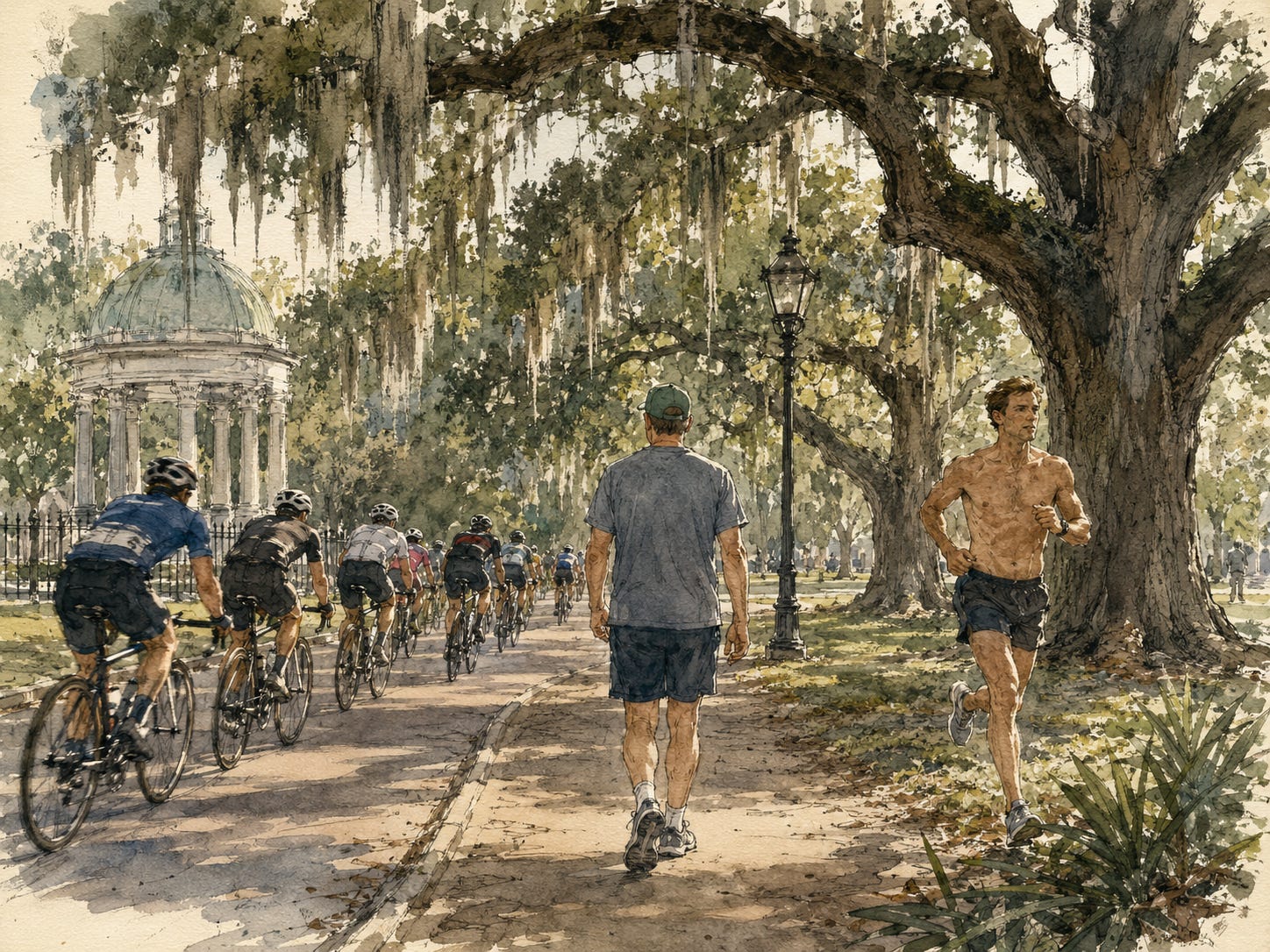
I get lapped on my third loop. Hampton Park on a Tuesday morning, and I’m walking the old horse racing track before the sun gets too high. A cyclist in lycra hisses past. Then another. Not long after them is a shirtless man with the shoulders of someone training for a Hyrox competition. I’m not unfit and everywhere else in America I’d be doing fine. But here on the Charleston peninsula, fine means a sub-twenty 5K and visible obliques.
Drive an hour inland and the usual American settlement pattern resumes. Bigger roads, bigger cars, bigger people. The peninsula filters, the way any decent beach or mountain town filters. Nowhere else in America does.
People ask why I picked Charleston, and I usually start with the answer about walkability or the food, then trail off because the real answer is harder to put in a sentence. I picked it on purpose and the longer I live here the more reasons I find that justify what was, at the start, mostly a feeling.
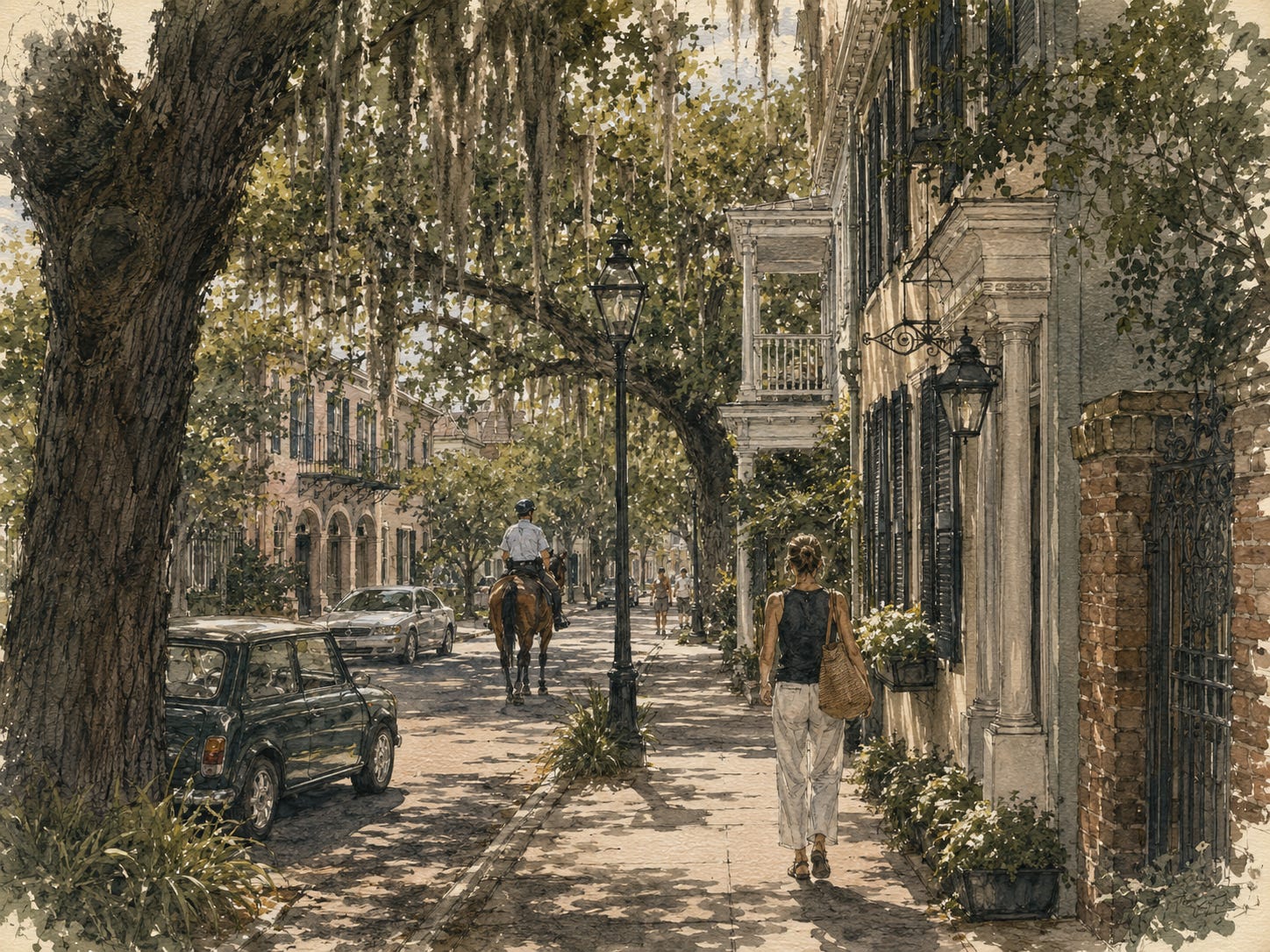
Out of the park I walk south. The streets are lived in, not just sidewalks between car parks like elsewhere in this country. Buildings sit close to the road and close to each other. The live oaks and their Spanish Moss shade the pavements in summer when the air is warm and humid. You bump into someone you know every day. This is the only lesser-known American city I’ve found where walking works the way it works in London, where I grew up.
I stop at Baba’s for a cortado and sit outside. They know what they’re doing here, and pass John Cena’s Flat White Test. At the next table a couple are telling a tourist that no, it’s Legree, not Le-GARE like the street’s sign reads. There are pronunciation traps that will out a tourist within five minutes of small talk and make a Londoner feel at home. Vanderhorst is Vandross. Huger is Yugee. It’s no different to knowing how to say Marylebone and Cholmondeley. Both cities have continuous Anglo populations that never had to surrender the shibboleths.
Our dog is called Birdie. I tell people his name and they hear “Buddy” and assume I’m a local. South Carolina becomes Sah Calina. You get called Bo by men who don’t know your name and never will. The drawl sounds like an English gentleman who emigrated to the West Indies in 1850. You hear it less in twenty-year-old and almost not at all in the new arrivals from Ohio. Admitting to being a transplant in this town marks you out, and being one from Ohio is like being a leper.
I cut across Francis Marion Square. The local bachelors call it the ‘Charleston Beach' for the sorority girls sunbathing in the grass, and they invent errands to walk through it. South of Calhoun the alleys narrow. Too narrow for the giant Suburbans and Grand Wagoneers the rest of the country insists on driving. Try to bring one of those four-wheeled behemoths down the 18th Century Stoll’s Alley and it’s not coming back out.
Parking is hostile to anything bigger than a sedan, and Charleston is one of the only American towns besides New York where I have met young professionals who don’t even own cars. After all, cars are the single biggest enemy of an enjoyable city.
Two mounted police officers come the other way down Tradd Street, the horses stepping gingerly over the old cobbles. You don’t see that in Scottsdale or Houston. Cities built to a human scale can use mounted officers. Cities built for the SUV cannot.
Charleston is what David Hackett Fischer called the Cavalier capital in Albion’s Seed, the antithesis of Roundhead Boston. Anglo by inheritance, Anglican by default, fond of horses and drink. The heritage hasn’t been buried under continental European migration the way it has further north. The Hispanic and Asian growth that has reshaped most of the country has been slow to arrive. The surnames still come mostly from the British Isles or from West Africa via the plantations. Many of the locals have the physiognomies of people who held the line at Crecy, Waterloo and Balaclava. The architecture could be lifted out of Mayfair and dropped on Tradd Street with an open porch stuck to the side.
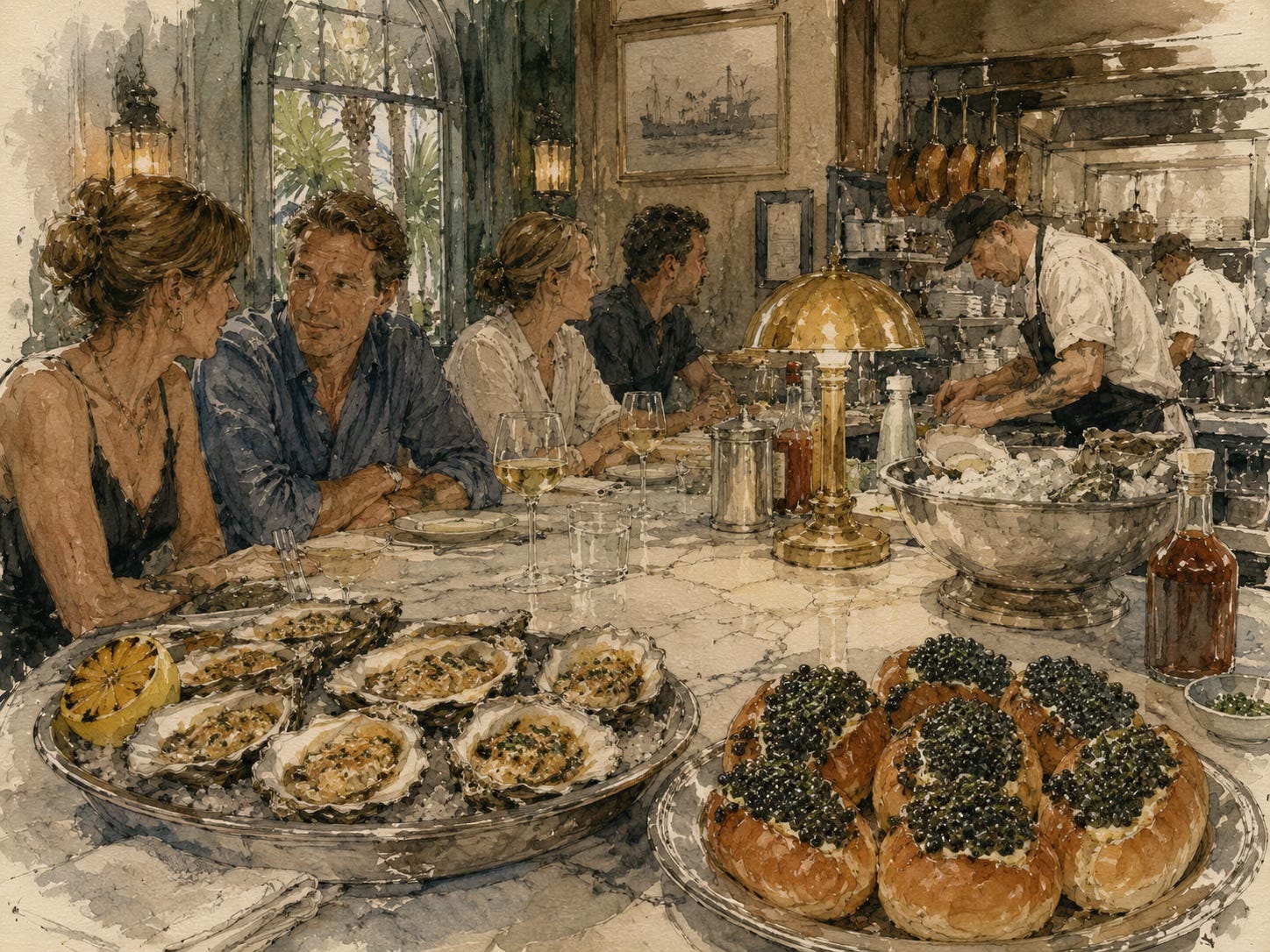
Mid-afternoon, queueing outside Chubby Fish with friends. They don’t take reservations. You queue or you pay one of the professional black-market queuers fifty dollars on Venmo to hold a spot. The line is the price of admission and most people pay it cheerfully, because once you’re sat down the kitchen sends out local oysters grilled in crab fat on the half shell, and then a small mountain of caviar on buttered Hawaiian rolls. Then you order another plate of caviar on Hawaiian rolls.
Michelin added Chubby Fish last year. They added Leon’s too, a few blocks down, where you can get fried chicken and hush puppies with a Michelada – with an extra pony of High Life on the side. The men’s bathroom at Leon’s is wallpapered with old soft porn magazines.
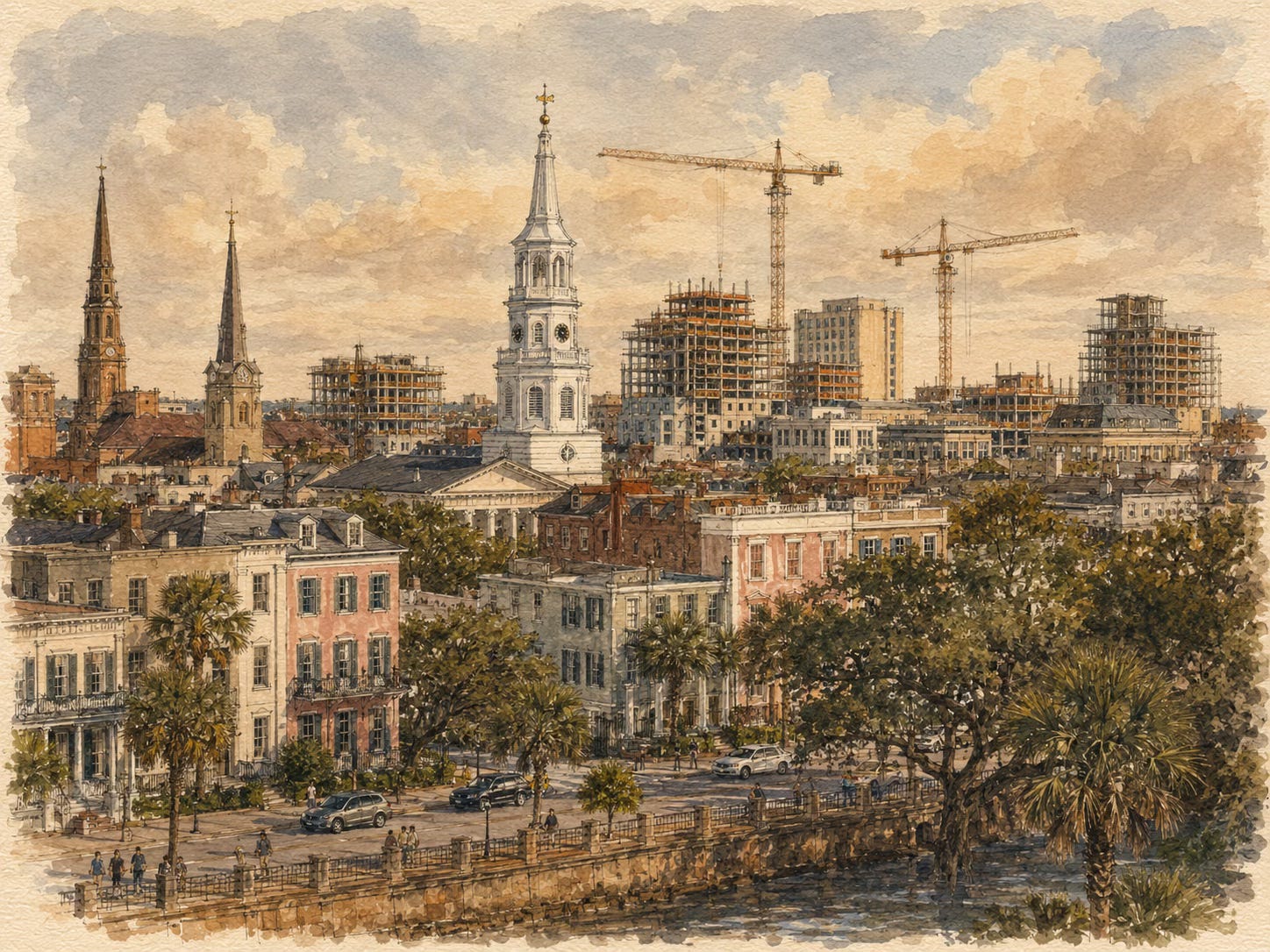
Walking back from lunch you start to notice the cranes. It is slightly jarring as an Englishman that things are being built here. In London, the future sometimes felt like it was happening somewhere else. But the cranes are up in Charleston. Downtown is densifying.
The new buildings are mostly in the vernacular thanks to the Board of Architectural Review, which insists on stylistic sympathy from developers and was the first such board in the US. The suburbs are growing at a pace that worries many, but there’s nowhere else for them to go. It turns out having an old, dense city doesn’t stop you from building in it. NIMBYs don’t flourish here the way they do back home.
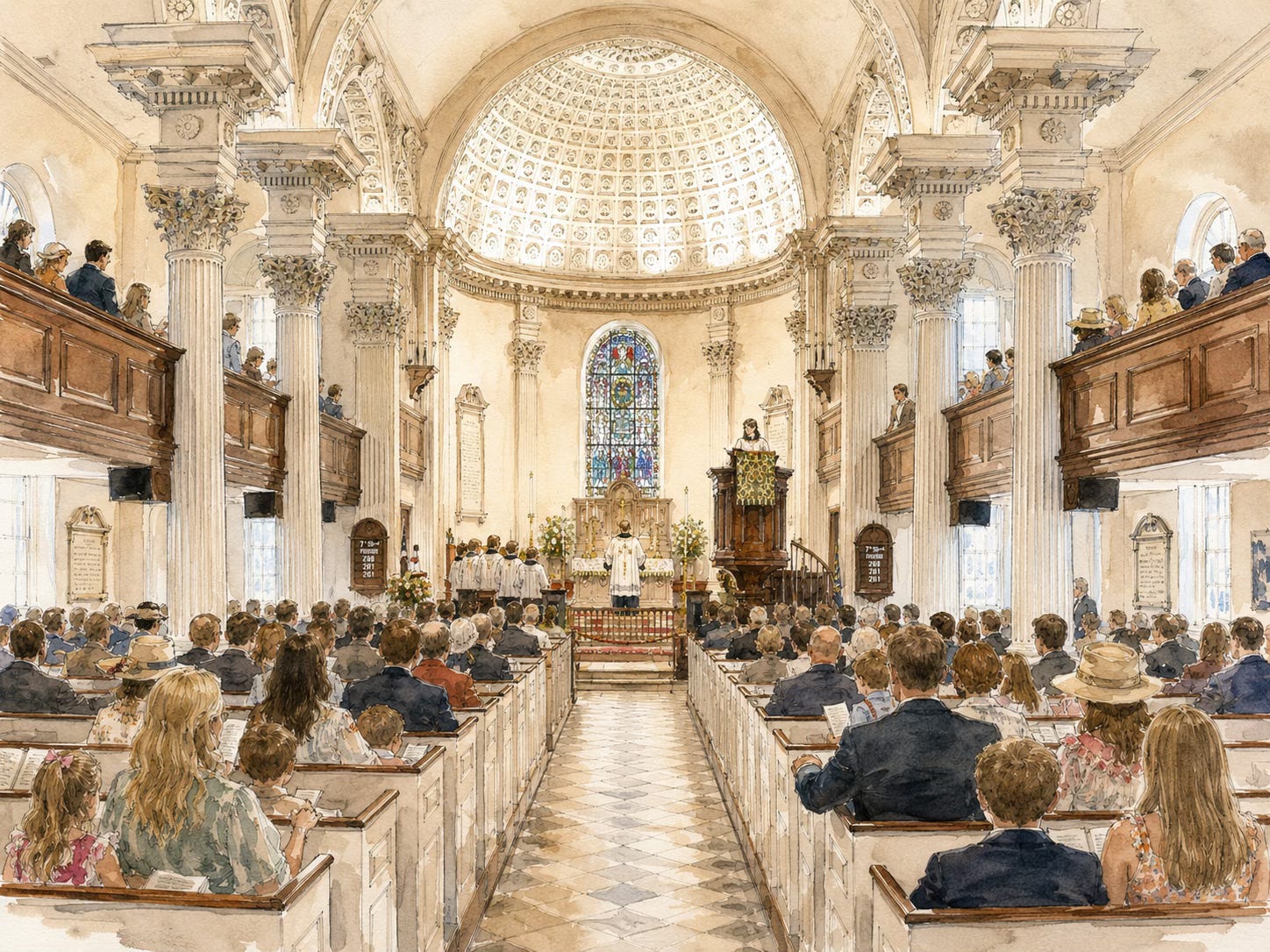
Later, the light goes soft and I walk south toward St Philip’s. On Tuesdays, its vicar holds Theology on Tap at a local bar called Henry’s. The seats fill with Zoomers and the good reverend takes the room through C.S. Lewis.
This isn’t your local CofE blue-rinse parish, but nor is it megachurch America. You’d need to go to the suburbs across the Ashley River for that, nobody is shouting or shaking in the pews at St Philip’s. Most men wear a jacket and tie. As I told my friend Ed West when he visited, people just love God and the Book of Common Prayer. It’s what Cavalier piety looks like three centuries on.
Out the door and the harbour is two blocks away. The Civil War started in that water when a newly seceded South Carolina fired on the federal Fort Sumter. The southern campaign of the Revolution hinged on the Battle of Sullivan’s Island. The buildings around the Battery were standing before Lincoln was born. The Gibbes has serious paintings and the Halsey at the College of Charleston is showing better contemporary work than most places its size.
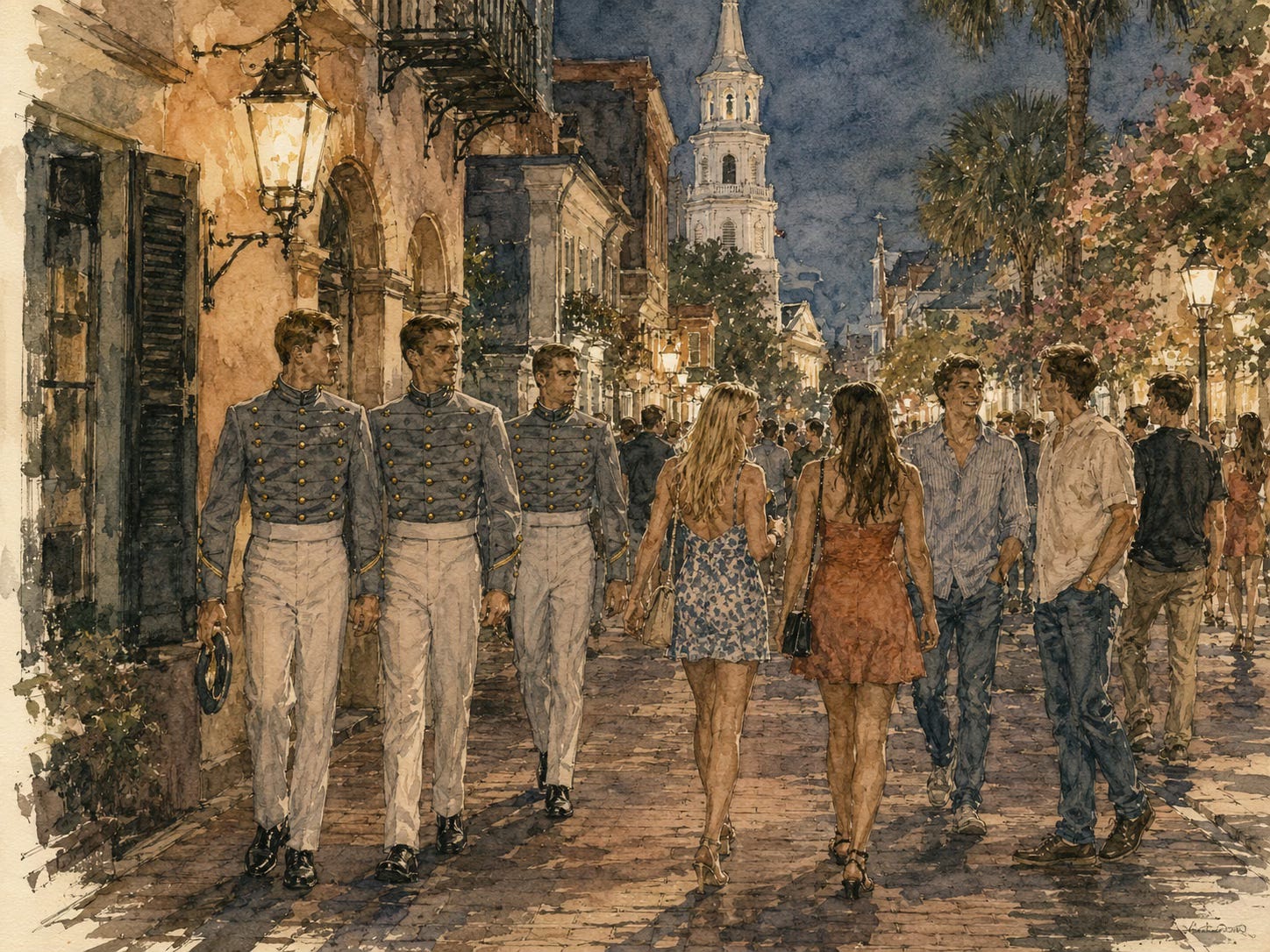
King Street fills up at dusk. Cadets from The Citadel come past in grey wool and brass buttons, in uniforms that have not changed much since the Civil War. They have to wear them within ten miles of campus. Some duck into back rooms and change out before going to the bars. Plenty don’t bother. They walk down King in full kit next to CofC kids in baggy jeans waving fake IDs.
Past the cadets, further down King, you see the other tribe the city grows. The thirty-five-year-old in a backwards cap and a pastel quarter-zip, with two friends in matching outfits, on his way to line up at Uptown Social. He hasn’t been on Hinge tonight. He’s going to “see what’s happening.” What’s happening, mostly, is that a CofC sophomore will humour him for one round of vodka sodas until her friends pull her away.
The locals call it Peter Pan Syndrome. Charleston lets this happen for longer than it should. The girls he bought drinks for at twenty-five have children now. The girls he’s buying for tonight were in middle school when he graduated.
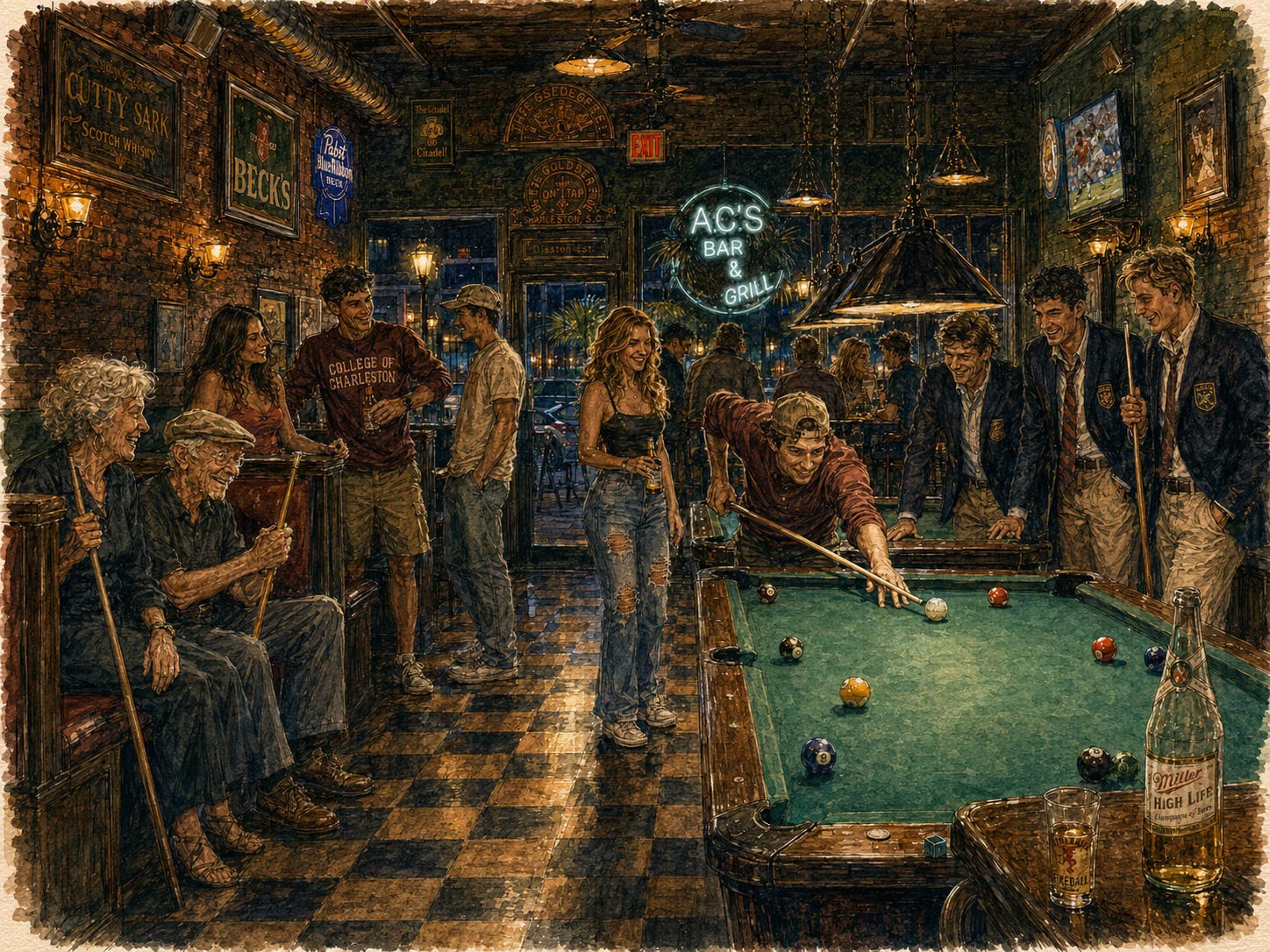
You cross the street to avoid him and duck into AC’s Bar and Grill. You leave your quarter on the pool table, grab a Miller and a shot of Fireball, hustle a Yankee college kid in a striped polo shirt called Colby, then get hustled yourself by an elderly couple from Summerville who brought their own cues.
Walking home back up Meeting Street late, the streets still warm from the day. The CVS is closed for the night with the toothpaste sitting on the shelves, not behind plexiglass. People leave laptops on café tables and come back to find them. The most common crime is DUI, not phone snatching, and there are fewer than a hundred homeless in the whole county. Public space here still belongs to the public, not to whoever is most willing to make everyone else uncomfortable. I had forgotten what it's like to be in a city where that was true.
The people yearn for walkable cities! Loved this
I loved Charleston when I was there. Loveliest city in America. Savannah runs it a close second.